Global View
.jpg)

Science Act is committed to upholding the highest standards of publication ethics and integrity. We adhere to the Core Practices of the Committee on Publication Ethics (COPE) and follow COPE guidelines for editors, reviewers, and authors. This policy outlines the ethical responsibilities and procedures that govern our editorial process.
Ensure fair, unbiased, and timely peer review.
Maintain confidentiality of submissions.
Make editorial decisions based on scholarly merit and relevance.
Address allegations of misconduct using COPE flowcharts.
Disclose conflicts of interest and recuse when necessary.
Submit original work free of plagiarism or data fabrication.
Accurately represent authorship and contributions.
Disclose all conflicts of interest.
Obtain ethical approvals for studies involving humans or animals.
Provide data availability statements and share data when possible.
Evaluate manuscripts objectively and confidentially.
Declare any conflicts of interest.
Provide constructive feedback within the agreed timeframe.
Avoid using unpublished data for personal advantage.
Science Act investigates all allegations of misconduct, including:
Plagiarism
Data falsification or fabrication
Duplicate publication
Authorship disputes
Undisclosed conflicts of interest
We follow COPE’s flowcharts and recommendations to guide our decisions. Proven misconduct may result in rejection, retraction, or notification to institutions.
Science Act follows COPE’s Retraction Guidelines. Retractions, corrections, and expressions of concern are issued when:
Findings are unreliable
Ethical breaches are confirmed
Errors significantly affect interpretation
All notices are clearly labeled and linked to the original article.
Authors are encouraged to:
Share datasets in public repositories
Include data availability statements
Follow FAIR data principles when applicable
All parties must disclose financial, institutional, or personal relationships that could influence their work. Science Act publishes conflict of interest statements with each article.
Science Act reserves the right to:
Request documentation of ethical approvals
Audit data and methodology
Reject submissions that violate ethical standards
Science Act follows the COPE Core Practices: https://publicationethics.org/core-practices
We use COPE flowcharts to guide decisions: https://publicationethics.org/guidance/Flowcharts
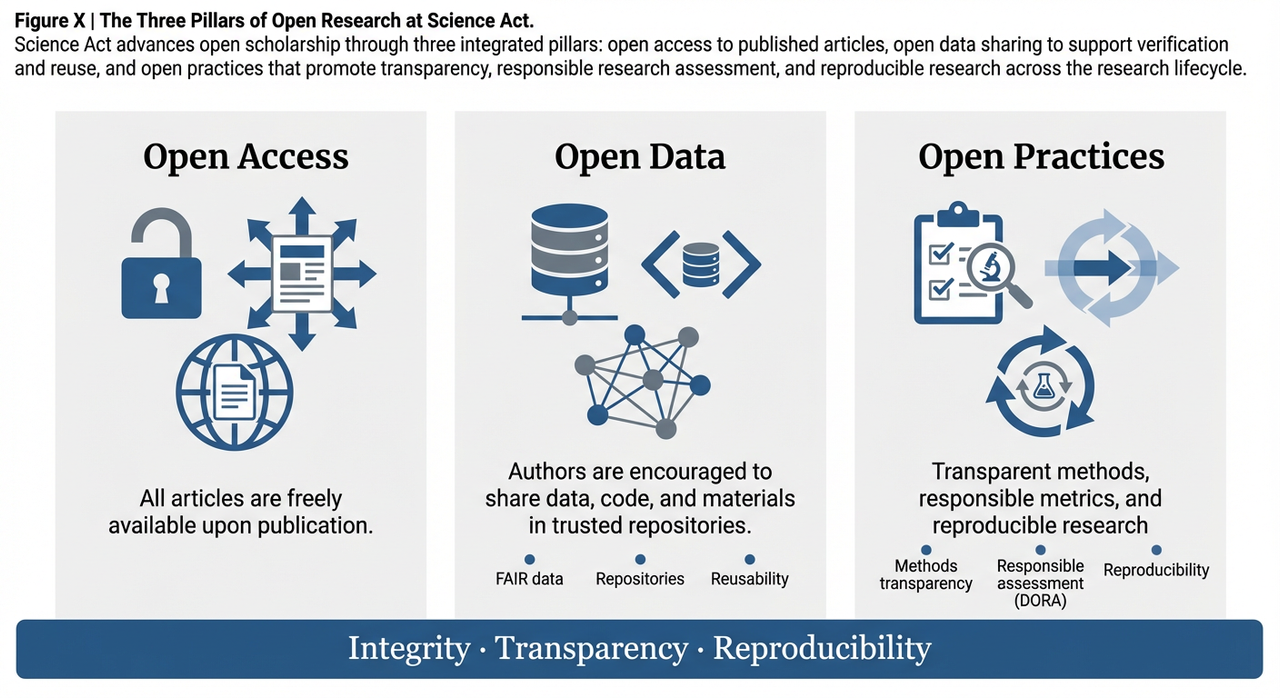
Open research is not a distant vision — it is the foundation of modern scholarly communication.
At Science Act, we believe that scientific progress accelerates when knowledge is openly shared, transparently documented, rigorously verified, and fully reproducible. Removing barriers to access ensures that research outputs can be used by anyone, anywhere, fueling discovery, innovation, and global collaboration.
Our dedication to advancing open scholarship
Our dedication to advancing open scholarship is built on our Three Pillars of Open Research, designed to give authors and readers the strongest possible publishing environment:1. Open Access, 2. Open Data, 3. Open Practices
Science Act is dedicated to accelerating global research discovery by championing open access, open data, and transparent research practices across every stage of the publishing process. Our commitment to openness is strengthened through active participation in, or alignment with, leading international initiatives that advance responsible, equitable, and reproducible science. By endorsing or supporting the following organizations and principles, we help ensure that research remains accessible, verifiable, and impactful for communities worldwide:
International Science Council: The World Data System Applied for Membership.
FORCE 11 FAIR Data Principles Endorsed.
STM Brussels Declaration Committed to open and responsible research.
Initiative for Open Citations (I4OC) Committed to open citation data.
CHORUS Committed to open and compliant research.
Initiative for Open Abstracts (I4OA) Committed to open abstracts.
Science Act is committed to the principles of the San Francisco Declaration on Research Assessment DORA. Through our editorial leadership, we support responsible research assessment practices that prioritize the intrinsic quality and impact of research over journal‑based metrics.
All accepted articles are eligible for full publication funding under the Science Act Flagship Journal Program. Funding support is guaranteed for manuscripts published before 2027, ensuring that authors face no article processing charges and can benefit from broad dissemination of their work. This initiative reflects our commitment to supporting high-quality scientific research and fostering global accessibility to new knowledge. For more information please check Funding programs.
Cookies are used by this site.
“Authors retain copyright of their work and grant Journal Science Act a non-exclusive license to publish the article under the CC BY 4.0 agreement.”
Attribution 4.0 International (CC BY 4.0) Deed: https://creativecommons.org/licenses/by/4.0
Science Act is a multidisciplinary journal that focuses on advancing scientific knowledge across various fields. It publishes original research, reviews, and articles that explore diverse areas of science, including biology, chemistry, physics, engineering, and environmental sciences. The journal employs a rigorous peer-review process, ensuring the quality and credibility of the content it publishes. This process fosters the validation of research findings and encourages scholarly dialogue. By bridging the gap between different scientific disciplines, Science Act serves as a platform for collaboration, innovation, and the dissemination of groundbreaking discoveries that address global challenges.
ISSN: 3115-7262
Advancing scientific knowledge through rigorous research, interdisciplinary thinking, and evidence-based discovery.